
JLPT N5: Complete as frases com quatro alternativas - Unsolved

Pratique 40 pontos de gramática do JLPT N5 completando lacunas em frases com quatro alternativas, com a tradução em português como dica e a explicação e a forma de conexão após responder.
-
で
-
を
-
と
-
けれど
-
が
-
か
-
なかったので
-
ても
-
ましょうか
-
ではありません
-
ではありませんでした
-
でした
- 助動詞「です」は丁寧な断定を表す。
- 未然形「でしょ」は通常「う」を伴って「でしょう」となる。
- 仮定形「ですれ」は「ですれば」などで用いられるが、現代語では硬く稀。
- 命令形は通常用いられない。
-
てください
-
ませんか
-
たことがある
- 「~ている」は補助動詞「いる」の形で、動作の進行または結果状態を表す。
- 口語では「い」が脱落して「~てる/~でる」となることが多い。
- 前接語の音便などにより「ている」「でいる」を使い分ける。
-
なかった
-
たことがある
-
たことがない
-
がいます
-
になります
-
がします
-
の
-
ほう
-
つもり
-
を
-
と
-
に
-
ませんでした
-
ました
-
すぎました
- 「ましょう」は助動詞「ます」の丁寧な意志・勧誘を表す形で、独立した活用は基本的に持たないため、欠ける形は null とした。
あした、学校( )行きます。
に
あした、学校( )行きます。
に
Explanation
あした、学校( )行きます。
に
「に」 vem depois de um lugar para indicar o destino de um movimento; também pode marcar um horário específico.
場所の名詞+に+移動動詞
に
para; em direção a / para; a fim de

「なぜ家にいるのですか。」「雨が降っています( )、家にいます。」
Hint
“Por que você está em casa?” “Estou em casa porque está chovendo.”
「なぜ家にいるのですか。」「雨が降っています( )、家にいます。」
から
「なぜ家にいるのですか。」「雨が降っています( )、家にいます。」
から
Explanation
「なぜ家にいるのですか。」「雨が降っています( )、家にいます。」
から
「から」 vem depois de uma oração e apresenta o motivo da informação seguinte. Pode seguir tanto a forma simples quanto a forma polida.
普通形・丁寧形+から(理由)
~から
porque / já que / visto que

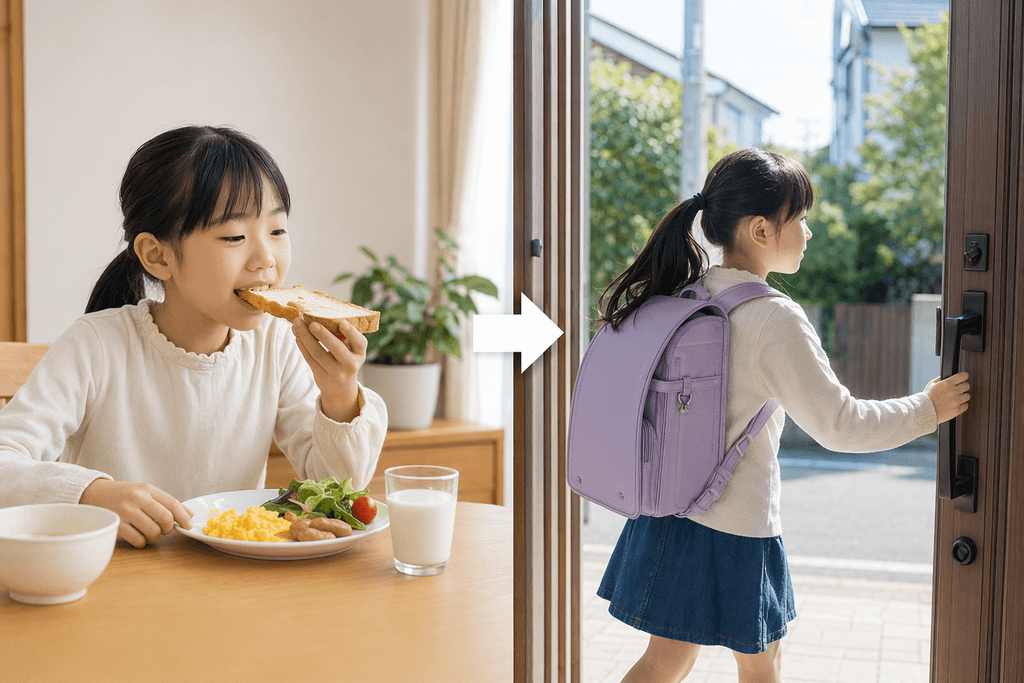
朝ごはんを食べ( )、学校へ行きます。
Hint
Depois de tomar café da manhã, vou para a escola.
朝ごはんを食べ( )、学校へ行きます。
てから
朝ごはんを食べ( )、学校へ行きます。
てから
Explanation
朝ごはんを食べ( )、学校へ行きます。
てから
「てから」 indica que a primeira ação é concluída antes da segunda. A expressão destaca a ordem das duas ações.
動詞て形+から
~てから
depois de (fazer algo) / após ter feito (algo) / só depois que (algo acontece)
「今は学生ですか。」「はい、わたしは学生( )。」
Hint
“Você é estudante atualmente?” “Sim, sou estudante.”
「今は学生ですか。」「はい、わたしは学生( )。」
です
「今は学生ですか。」「はい、わたしは学生( )。」
です
Explanation
「今は学生ですか。」「はい、わたしは学生( )。」
です
「です」 vem depois de um substantivo ou adjetivo para indicar identidade, característica ou estado de forma educada.
名詞・な形容詞語幹+です/い形容詞+です
です
ser/estar (forma polida) / verbo copulativo que expressa identidade, característica ou estado / equivalente a “é/sou/são/está”

Word Forms
The basic and commonly used forms of this auxiliary verb.
Basic forms
| Form | Word form | Usage |
|---|---|---|
| Imperfective form (mizenkei) |
Alternative:
でせ
|
Available forms depend on the auxiliary verb. |
| Continuative form (renyokei) | Available forms depend on the auxiliary verb. | |
| Conclusive form (shushikei) | The basic form carrying the grammatical function. | |
| Attributive form (rentaikei) | Usage depends on the surrounding words. | |
| Conditional form (kateikei) | Used when the auxiliary participates in a conditional expression. | |
| Imperative form (meireikei) | This form is not normally used for this word. | Some auxiliaries do not have this form. |
Common forms
| Form | Word form | Usage |
|---|---|---|
| No displayable derived forms are available. | ||
Notes
いま、わたしは日本語を勉強し( )。
Hint
Agora, estou estudando japonês.
いま、わたしは日本語を勉強し( )。
ている
いま、わたしは日本語を勉強し( )。
ている
Explanation
いま、わたしは日本語を勉強し( )。
ている
「ている」 indica uma ação em andamento ou um estado que continua após uma ação. Nesta frase, indica que a pessoa está estudando agora.
動詞て形+いる
~ている
estar fazendo (ação em curso) / ter feito (estado resultante) / fazer habitualmente (ação recorrente)

Word Forms
The basic and commonly used forms of this auxiliary verb.
Basic forms
| Form | Word form | Usage |
|---|---|---|
| Imperfective form (mizenkei) |
Alternative:
て
でい
で
|
Available forms depend on the auxiliary verb. |
| Continuative form (renyokei) |
Alternative:
て
でい
で
|
Available forms depend on the auxiliary verb. |
| Conclusive form (shushikei) |
Alternative:
てる
でいる
でる
|
The basic form carrying the grammatical function. |
| Attributive form (rentaikei) |
Alternative:
てる
でいる
でる
|
Usage depends on the surrounding words. |
| Conditional form (kateikei) |
Alternative:
てれ
でいれ
でれ
|
Used when the auxiliary participates in a conditional expression. |
| Imperative form (meireikei) |
Alternative:
てろ
ていよ
でいろ
でろ
でいよ
|
Some auxiliaries do not have this form. |
Common forms
| Form | Word form | Usage |
|---|---|---|
| Te-form equivalent |
Alternative:
てて
でいて
でて
|
Available for some auxiliaries. |
| Ta-form equivalent |
Alternative:
てた
でいた
でた
|
May express past time or completion. |
| Nai-form equivalent |
Alternative:
てない
でいない
でない
|
May participate in negation. |
| Masu-form equivalent |
Alternative:
てます
でいます
でます
|
Used by words that express politeness. |
| Ba-form equivalent |
Alternative:
てれば
でいれば
でれば
|
May participate in conditional expressions. |
| Volitional equivalent |
Alternative:
てたり
でいたり
でたり
|
May express intention or conjecture. |
Notes
あしたテストがあるから、今夜べんきょうし( )。
Hint
Como tem prova amanhã, preciso estudar hoje à noite.
あしたテストがあるから、今夜べんきょうし( )。
なくちゃいけない
あしたテストがあるから、今夜べんきょうし( )。
なくちゃいけない
Explanation
あしたテストがあるから、今夜べんきょうし( )。
なくちゃいけない
「なくちゃいけない」 indica que é preciso ou obrigatório fazer algo. É a forma coloquial de 「なくてはいけない」.
動詞ない形の語幹+なくちゃいけない
~なくちゃいけない
ter que fazer / precisar fazer / é necessário fazer

机の上に本( )。
があります
机の上に本( )。
があります
Explanation
机の上に本( )。
があります
「があります」 vem depois de um substantivo para dizer educadamente que há um objeto ou uma planta; 「が」 marca aquilo que existe.
物・植物などの名詞+があります
~があります
há ~ / existe(m) ~ / tem ~

私は一度日本へ行った( )がある。
Hint
Eu já fui ao Japão uma vez.
私は一度日本へ行った( )がある。
こと
私は一度日本へ行った( )がある。
こと
Explanation
私は一度日本へ行った( )がある。
こと
「たことがある」 indica que alguém já teve a experiência de fazer algo. Use com a forma passada do verbo.
動詞た形+ことがある
~たことがある
já ter feito (algo) / ter tido a experiência de (fazer algo) / ter feito alguma vez

このクラスの中( )田中さんが一番背が高いです。
Hint
Nesta turma, o Tanaka é o mais alto.
このクラスの中( )田中さんが一番背が高いです。
で
このクラスの中( )田中さんが一番背が高いです。
で
Explanation
このクラスの中( )田中さんが一番背が高いです。
で
「の中で~が一番」 indica quem ou o que tem o grau mais alto de uma característica em um grupo. Primeiro se apresenta o grupo e depois se identifica quem se destaca.
名詞+の中で+名詞+が一番+形容詞
~の中で~が一番~
entre ..., ... é o mais ... / dentre ..., ... é o mais ... / de ..., ... é o mais ...

明日、公園で遊び( )。
Hint
Vamos brincar no parque amanhã.
明日、公園で遊び( )。
ましょう
明日、公園で遊び( )。
ましょう
Explanation
明日、公園で遊び( )。
ましょう
「ましょう」 se junta à base da forma educada do verbo para propor educadamente fazer algo juntos.
動詞ます形の語幹+ましょう
~ましょう
forma volitiva polida dos verbos / marca convite ou sugestão / usada para oferecer-se ou propor uma ação

Word Forms
The basic and commonly used forms of this auxiliary verb.
Basic forms
| Form | Word form | Usage |
|---|---|---|
| Imperfective form (mizenkei) | This form is not normally used for this word. | Available forms depend on the auxiliary verb. |
| Continuative form (renyokei) | This form is not normally used for this word. | Available forms depend on the auxiliary verb. |
| Conclusive form (shushikei) | The basic form carrying the grammatical function. | |
| Attributive form (rentaikei) | Usage depends on the surrounding words. | |
| Conditional form (kateikei) | This form is not normally used for this word. | Used when the auxiliary participates in a conditional expression. |
| Imperative form (meireikei) | This form is not normally used for this word. | Some auxiliaries do not have this form. |
Common forms
| Form | Word form | Usage |
|---|---|---|
| No displayable derived forms are available. | ||
Notes
Loading...

JLPT N5 文法・40項目 / JLPT N5 Grammar: 40 Points

JLPTと同じ形式の、例文の空欄に入る表現を4つから選ぶ文法40項目の問題集です。例文の訳はヒントに、文法の説明と接続の形は解答後の解説に表示されます。Jonathan Waller氏のJLPT Resourcesの文法リスト・レベル分類を出典とし、CC BYの条件に従ってDiQtが問題・説明・訳を作成しました。JLPT公式の文法リストではありません。
Practise 40 grammar points with sentence gap-fill questions in the same four-choice format as the JLPT. Sentence translations appear as hints, while grammar explanations and connection patterns appear after answering. Based on the grammar list and level classifications in Jonathan Waller’s JLPT Resources under CC BY, with questions, explanations and translations created by DiQt. This is not an official JLPT grammar list.
Key Operations
Select the first quiz:
Ctrl + Enter
View Explanation:Ctrl + G
Close a feedback:Esc
When selecting a quiz
Answer:Enter
Select a choice:↓ or ↑
Reading out the question:Ctrl + K
View Hint: Ctrl + M
I don't know: Ctrl + Y



